
【重磅演講|公正轉型 理論與實踐 Just Transiton Theory and Practice】
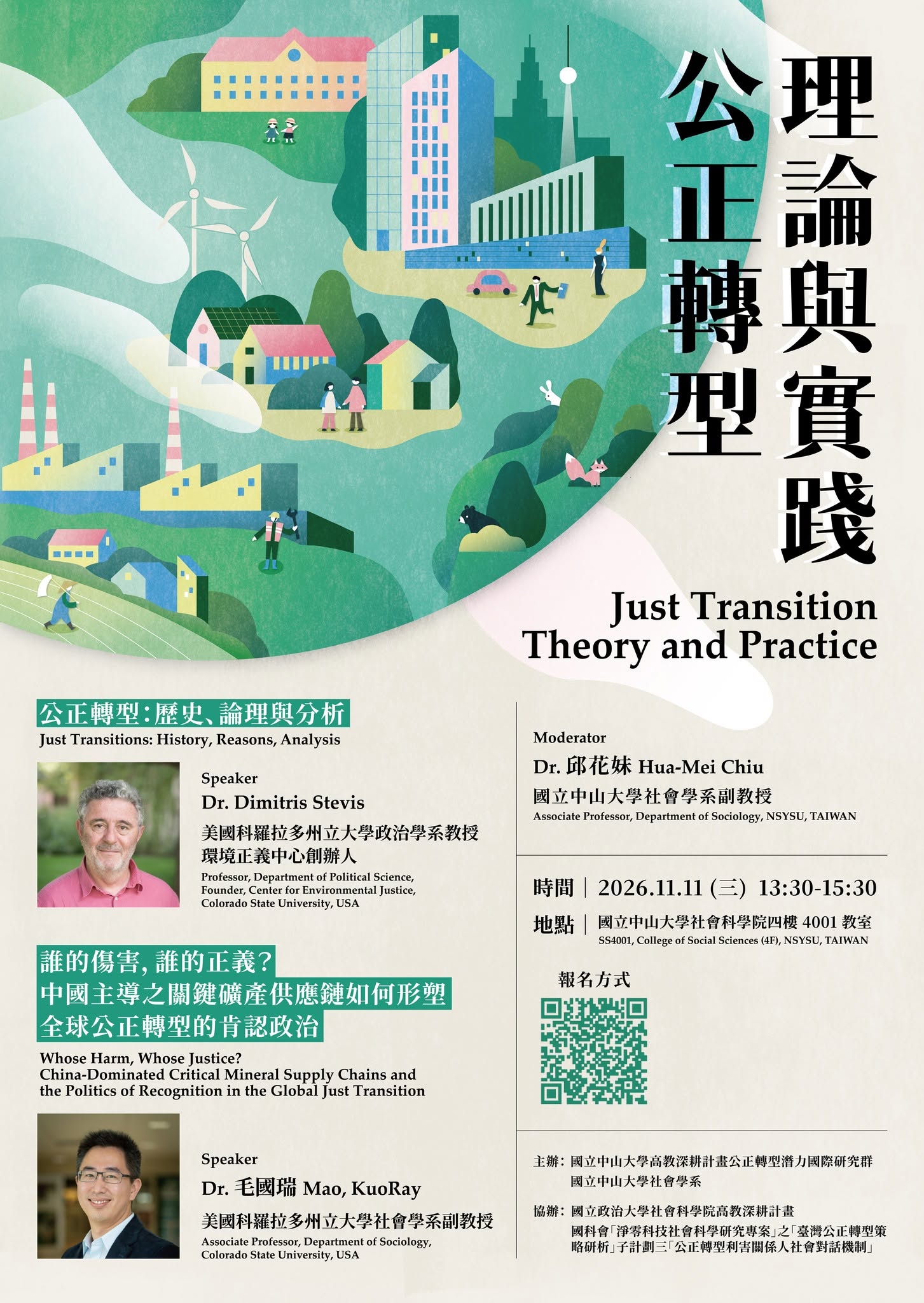
【南方社會學】國際級重磅演講!
這次很「南」,到底什麼是公正轉型?公正轉型怎麼轉?歷史脈絡的、概念的、環境與勞動的、南方的,來聽美國科羅拉多州立大學政治學者Dimitris Stevis與社會學者毛國瑞的開講,歡迎報名!
---------------------------
🌍 公正轉型是什麼?從環境正義、勞工權益到全球南方的觀點,帶你深入理解公正轉型的歷史、論理與實踐挑戰!**
國立中山大學邱花妹老師邀請兩位國際重量級學者,從政治學與社會學的不同視角,探討公正轉型的發展脈絡,以及全球關鍵礦產供應鏈背後的環境與社會正義問題。
🎙️ 講題一|公正轉型:歷史、論理與分析
👤 主講人|Dimitris Stevis 教授
美國科羅拉多州立大學政治學系教授、環境正義中心創辦人。研究專長為環境與勞工領域的國際政治經濟學,長期引領國際間「環境勞工研究」與「公正轉型」相關研究。
目前研究涵蓋全球工會組織如何透過「公正轉型」框架重建氣候政治、美國鋰礦生命週期與公正能源轉型,以及綠色與氣候就業等議題。
🎙️ 講題二|誰受傷害,誰的正義?中國主導的關鍵礦產供應鏈如何形塑全球公正轉型的承認政治
👤 主講人|毛國瑞教授
美國科羅拉多州立大學社會學系副教授、綠色犯罪學家,專攻非自由主義體制下的環境治理與自然資源管理,長期研究發展主義、生態危機與全球環境規範框架之間的複雜關係。
🌱 從環境與勞工的正義,到全球關鍵礦產供應鏈中的權力與承認,帶你從國際視野重新思考公正轉型的意義與挑戰!
📅 時間|2026/11/11(三)13:30-15:30
📍 地點|國立中山大學社會科學院四樓 4001 教室
🔗 活動報名|https://forms.gle/FkhcJiht2QDPyzze9
━━━━━━━━━━━━━━
🏛️ 主辦單位
國立中山大學高教深耕計畫公正轉型潛力國際研究群、國立中山大學社會學系
🤝 協辦單位
國科會「淨零科技社會科學研究專案」之「臺灣公正轉型策略研析」子計劃三「公正轉型利害關係人社會對話機制」、國立政治大學社會科學院高教深耕計畫
-------- -------- --------
【重磅演講|公正轉型 理論與實踐 Just Transiton Theory and Practice】
主持人|Dr. 邱花妹 Hua-Mei Chiu|國立中山大學社會學系副教授
Associate Professor, Department of Sociology, NSYSU, TAIWAN
(一)公正轉型:歷史、論理與分析
Just Transitions: History, Reasons, Analysis
講者|Prof. Dimitris Stevis|科羅拉多州立大學政治學系教授、環境正義研究中心創辦人
Professor, Department of Political Science, and Founder, Center for Environmental Justice, Colorado State University, USA
公正轉型策略正日益受到重視,同時也引發更多爭議、呈現更多樣的樣貌。本次演講目的並非在於提出公正轉型的通用定義,而是提供幾個觀察視角,以反思公正轉型政策與計畫,並藉此揭示其背後所蘊含的世界觀。
第一個視角是歷史:這項策略從何而來?為何出現?它如何隨時間演變?原因為何?它能否/是否應該應用於整個政治經濟體系?它對地方到全球層級的環境治理有何影響?
第二個視角是論理:我們所說的「轉型」是什麼意思?它如何融入更廣泛的政治經濟與治理體系?所有轉型是否都值得追求?任何轉型都能夠實現「公正」或「永續」嗎?
基於這些視角,我將提出一個可以應用於公正轉型、與其他追求公正的生態—社會變革政策、及其治理的分析架構,以詮釋、評估和比較使用「公正轉型」一詞的政策與計畫。這個歸納性的框架將焦點從政策的自我表述及其技術層面轉移開來,使我們能夠探究公正轉型政策所提倡的世界觀。
The strategy of just transition is growing in prominence, contestation and variability, as the recently initiated international conferences on the Just Transition Away from Fossil Fuels indicate. My objective is not to advance a common definition but to provide some vantage points for reflecting on just transition policies and projects in a manner that makes their worldviews more visible. The first is that of history. Where did the strategy come from and why? How has it unfolded over time and why? Can, and should, it be applied to across the political economy? What are its implications for environmental governance, from the local to the global? The second is that of reasons. What do we mean by transitions and how are they part of the broader political economy and governance? Are all transitions desirable? Can any transition be made just or sustainable? Informed by these vantage points I will suggest an analytical framework, which can also be applied to other policies for just ecosocial change and its governance, for interpreting, evaluating and comparing policies and projects that employ the term “just transition”. This inductive framework shifts the focus away from the self-representations of these policies, as well as their technical qualities alone, and allows us to investigate the world views that just transition policies advance.
(二)誰受傷害,誰的正義?中國主導的關鍵礦產供應鏈如何形塑全球公正轉型的承認政治
Whose Harm, Whose Justice? China-Dominated Critical Mineral Supply Chains and the Politics of Recognition in the Global Just Transition
講者|Associate Prof. 毛國瑞 Mao, KuoRay|美國科羅拉多州立大學社會學系副教授
Associate Professor, Department of Sociology, Colorado State University, USA
近年公正轉型研究逐漸將肯認正義、分配正義與程序正義並列為重要的分析面向。然而,肯認如何透過知識生產、證據標準與制度分類,影響哪些傷害得以被辨識、哪些人的主張能被採信,仍有待深入探討。本演講主張,肯認是實現分配與程序正義的必要前提,也是理解轉型不正義如何形成、何以持續的關鍵。傷害若從未被辨識,便無從彌補;當事人的知識與經驗若不被採信,也難以平等參與決策。援引南方知識論,本演講從政治經濟角度探討肯認如何運作:誰有權將一項開發認定為「綠色」?誰的陳述能被採為證據?哪些傷害與成本被排除在官方評估之外?政策分類、融資標準與認證制度影響資金流向,也影響傷害能否被辨識、責任能否被追究。當資本積累與工業轉型成為主要評估尺度,污染、土地及勞動條件等生產現場的代價,便可能在「綠色」發展的論述中遭到遮蔽。肯認的問題因此有助於解釋轉型不正義如何形成、何以持續。這些問題在中國主導的跨國關鍵礦產供應鏈中尤其迫切。遠離開採與加工現場的政府、金融機構及企業,其決策深刻影響在地社群的生活。本演講以講者對中國資本參與印尼鎳產業的持續研究為基礎,並將中國的綠色「一帶一路」以及中國對全球關鍵礦產供應鏈日益增強的控制力納入分析。這些問題在中國主導的跨國關鍵礦產供應鏈中尤其迫切。遠離開採與提煉現場的政府、金融機構及企業,其決策深刻影響在地社群的生活。本演講以講者對中國資本參與印尼鎳產業的持續研究為基礎,並將中國的「綠色」一帶一路發展倡議,以及中國對全球關鍵礦產供應鏈日益增強的控制力納入分析。藉此探討中國資本、技術與標準如何形塑全球南方各地對「綠色」、「公正」與「傷害」的界定。演講最後指出公正轉型研究仍須面對的難題:追溯綠色轉型的政治經濟如何透過制度安排造成傷並釐清跨境責任的歸屬。評估「全球公正轉型」的主張,須檢視知識分類與證據標準如何形塑各方行動,並影響傷害的辨識與責任的追究。
Recent scholarship on just transition has increasingly treated recognition justice as an important analytical dimension alongside distributive and procedural justice. Yet further attention is needed to how knowledge production, standards of evidence, and institutional classifications determine which harms become visible and whose claims are accepted. This talk argues that recognition is a necessary condition for distributive and procedural justice and a key to understanding how transition injustices arise and persist. Institutions cannot remedy harms they fail to identify; affected people whose knowledge and experience are discounted cannot participate on equal terms in decisions. Drawing on Southern epistemologies, the talk examines the political economy of recognition in just transitions. Who has the authority to define a development project as “green”? Whose account of its effects is accepted as evidence? Why are some harms omitted from official assessments? These practices of knowledge production and classification influence which projects receive financing and which costs enter decisions. When assessments privilege carbon reduction and industrial output while giving insufficient weight to local accounts of pollution, dispossession, and working conditions, affected communities may bear costs that the institutions directing the transition do not acknowledge. Recognition helps explain how these costs are obscured, why they persist, and whose objections are denied legitimacy. These questions are especially consequential in transnational critical-mineral supply chains, where decisions by governments, financial institutions, and firms far from production sites shape the lives of communities in mining and processing regions. The talk concludes by identifying unresolved challenges for just-transition research: tracing how the political economy of the green transition produces harm through institutional arrangements and determining where responsibility lies across borders. Evaluating claims of a global just transition requires examining how categories of knowledge and standards of evidence shape actors’ conduct, the recognition of harm, and the pursuit of accountability.
活動開始日期:
2026-11-11
活動結束日期:
2026-11-11
活動時間:
13:30
活動地點:
社SS4001
活動類型:
教研卓越
主辦單位:
高教深耕計畫公正轉型潛力國際研究群、社會學系
聯絡人:
陳美玲
聯絡分機:
5651
 20261111.jpg
瀏覽數:
分享
